


|
Quantity
|
Out of stock
|
||
|
|
|||
HFE-200 “Nadiya-4” High-Frequency Electrosurgical Unit — up to 200 W
HFE-200 “Nadiya-4” is a high-frequency electrosurgical unit designed for cutting, blended cutting, and monopolar and bipolar coagulation of soft tissues and blood vessels. The model provides an output power of up to 200 W in the cutting modes and up to 120 W in the coagulation modes at the corresponding optimum load.
The unit supports four electrosurgical modes: “РІЗАННЯ-1” (CUT-1), “РІЗАННЯ-2” (CUT-2), “КОАГУЛЯЦІЯ-М” (MONOPOLAR COAGULATION) and “КОАГУЛЯЦІЯ-Б” (BIPOLAR COAGULATION). The main frequency of the output high-frequency signal is 440 kHz in the pure-cut, monopolar coagulation and bipolar coagulation modes. The blended-cut mode uses pulse-amplitude modulation of the HF oscillations at 22 ± 2.2 kHz.
Separate digital displays and control buttons allow the cutting and coagulation power levels to be adjusted independently. The dual-pedal footswitch enables hands-free activation of the required function, while the patient return electrode monitoring system and visual and audible signals help the operator monitor the unit during use.
Key features of the HFE-200: cutting power up to 200 W, coagulation power up to 120 W, a 440 kHz operating frequency, four operating modes, monopolar and bipolar applications, independent power adjustment, a dual-pedal footswitch, patient return electrode cable monitoring, and protection against defibrillator discharge.
Benefits of the HFE-200 Electrosurgical Unit
Cutting power up to 200 W
The pure-cut and blended-cut modes provide a maximum output power of 200 W at the corresponding optimum load.
Coagulation power up to 120 W
A maximum output power of 120 W is available for monopolar and bipolar coagulation.
Four operating modes
The unit combines pure and blended cutting with monopolar and bipolar coagulation.
Independent parameter adjustment
The cutting and coagulation power levels are set independently and shown on two separate digital displays.
Monopolar and bipolar instruments
Separate “ПАС” (PATIENT RETURN), “АКТ” (ACTIVE) and “БІ” (BI) connectors are provided for the patient return electrode, active monopolar instrument and bipolar instrument.
Dual-pedal footswitch
The left pedal activates cutting and the right pedal activates coagulation, simplifying switching between functions during surgery.
Patient return electrode monitoring
If the cable is disconnected, has poor contact or is broken, the unit displays the “Err PE” message and generates a double audible signal.
Protection against defibrillator discharge
The applied-part design provides protection against the effects of defibrillator discharge.
HFE-200 Operating Modes
РІЗАННЯ-1 (CUT-1)
Monopolar pure-cut mode.
When activated, the generator produces continuous HF oscillations at a main frequency of 440 kHz. Optimum load: 200 ohms. Maximum power: 200 W. Minimum power: 10 W.
РІЗАННЯ-2 (CUT-2)
Monopolar blended-cut mode.
The output high-frequency oscillations use pulse-amplitude modulation at 22 ± 2.2 kHz. Optimum load: 100 ohms. Maximum power: 200 W. Minimum power: 10 W.
КОАГУЛЯЦІЯ-М (MONOPOLAR COAGULATION)
Monopolar coagulation.
The generator produces continuous HF oscillations at a main frequency of 440 kHz. Optimum load: 50 ohms. Maximum power: 120 W. Minimum power: 5 W.
КОАГУЛЯЦІЯ-Б (BIPOLAR COAGULATION)
Bipolar coagulation.
HF current flows between the two working tips of the bipolar forceps and localises the effect within the grasped tissue. Main frequency: 440 kHz. Optimum load: 50 ohms. Maximum power: 120 W. Minimum power: 5 W.
Power Control and Indication
The output power is adjusted in discrete steps from the minimum to the maximum value in all modes. Separate buttons are provided to increase or decrease the cutting and coagulation power. The selected values are shown on digital displays in relative units.
The power levels are stored separately for each function and operating mode. This allows the cutting and coagulation parameters to be preset and the required function to be activated during surgery with the corresponding foot pedal.
Visual indication
- green indicator — mains power is supplied;
- yellow indicator on the yellow field — selected cutting mode;
- yellow indicator on the blue field — selected coagulation mode;
- red digital displays — selected output power level;
- “Err PE” message — patient return electrode cable disconnected, poorly connected or broken.
Audible signalling
- continuous audible signal — output power is being delivered in cutting mode;
- periodic single signal — coagulation mode is active;
- periodic double signal — patient return electrode cable disconnected or broken.
Principle of Electrosurgical Action
The HFE-200 is a source of high-frequency current. HF voltage is applied to the active and patient return monopolar electrodes or to the bipolar forceps and delivered to the tissue in the surgical field.
Monopolar application
The “РІЗАННЯ-1” (CUT-1), “РІЗАННЯ-2” (CUT-2) and “КОАГУЛЯЦІЯ-М” (MONOPOLAR COAGULATION) modes use an active electrode and a patient return electrode. The active electrode has a much smaller working surface, producing a high current density and local tissue heating at the point of contact. Depending on the selected mode and power level, this provides cutting or coagulation.
Bipolar application
In the “КОАГУЛЯЦІЯ-Б” (BIPOLAR COAGULATION) mode, both working tips of the bipolar forceps are active. High-frequency current passes between them through the grasped tissue, locally heating it and producing protein coagulation. The electrosurgical effect is concentrated between the instrument tips.
Technical Specifications of the HFE-200 “Nadiya-4”
| Equipment type | High-frequency electrosurgical unit |
| Model | HFE-200 “Nadiya-4” |
| Operating states | Standby, cutting, coagulation |
| Modes | РІЗАННЯ-1 (CUT-1), РІЗАННЯ-2 (CUT-2), КОАГУЛЯЦІЯ-М (MONOPOLAR COAGULATION), КОАГУЛЯЦІЯ-Б (BIPOLAR COAGULATION) |
| РІЗАННЯ-1 (CUT-1) | 200 ohms; 10–200 W |
| РІЗАННЯ-2 (CUT-2) | 100 ohms; 10–200 W |
| КОАГУЛЯЦІЯ-М (MONOPOLAR COAGULATION) | 50 ohms; 5–120 W |
| КОАГУЛЯЦІЯ-Б (BIPOLAR COAGULATION) | 50 ohms; 5–120 W |
| Load range | 10–5000 ohms |
| Main HF signal frequency | 440 kHz for РІЗАННЯ-1, КОАГУЛЯЦІЯ-М and КОАГУЛЯЦІЯ-Б |
| Modulation in РІЗАННЯ-2 mode | 22 ± 2.2 kHz |
| Maximum output voltage | Up to 450 V in РІЗАННЯ-1, РІЗАННЯ-2 and КОАГУЛЯЦІЯ-М modes; up to 250 V in КОАГУЛЯЦІЯ-Б mode |
| Output current limit | No more than 4.0 A |
| Power adjustment | Discrete, from minimum to maximum level |
| Supply voltage | 220 ± 22 V |
| Mains frequency | 50 ± 0.5 Hz |
| Power consumption | Not more than 450 ± 10% VA |
| Ready time after switch-on | No more than 5 seconds |
| Duty cycle | 10 seconds of HF current delivery / 30-second pause |
| Maximum operating time | Up to 8 hours, provided that the intermittent duty cycle is observed |
| Electronic unit dimensions | 290 × 220 × 130 mm |
| Footswitch dimensions | 230 × 195 × 45 mm |
| Electronic unit weight | No more than 4 kg |
| Footswitch weight | No more than 1.5 kg |
| Footswitch cable length | At least 3.5 m |
| Specified service life | At least 5 years |
| Mean time between failures | At least 1000 hours |
Classification and Degrees of Protection
| Climatic version | UHL 4.2 |
| Resistance to mechanical effects | Group 2 |
| Class according to possible consequences of failure | Class B |
| Protection against electric shock | Class II, BF-type applied part |
| Degree of protection of the electronic unit | IP24 |
| Degree of protection of the footswitch | IPX7 |
| Risk class | IIb |
| Defibrillator protection | Provided |
Package Contents
| No. | Item | Designation | Quantity |
|---|---|---|---|
| 1 | Electronic unit | — | 1 pc. |
| 2 | Dual-pedal footswitch | B-001 | 1 pc. |
| 3 | Patient return (neutral) electrode | B-003 | 1 pc. |
| 4 | Monopolar electrode holder for Ø 2.0 mm electrodes | B-005 | 1 pc. |
| 5 | Bipolar forceps holder | B-007 | 1 pc. |
| 6 | Straight bipolar forceps, 200 mm | PP-007 | 1 pc. |
| 7 | Straight blade electrode | 04500 | 1 pc. |
| 8 | Curved blade electrode | 04500 | 1 pc. |
| 10 | Operating manual | — | 1 pc. |
| 11 | Packaging for the unit | — | 1 pc. |
Design and Controls
The HFE-200 consists of an electronic unit and a separate dual-pedal footswitch. The front panel contains digital displays, mode and power selection buttons, and connectors for monopolar, bipolar and patient return electrodes.
Front panel of the electronic unit
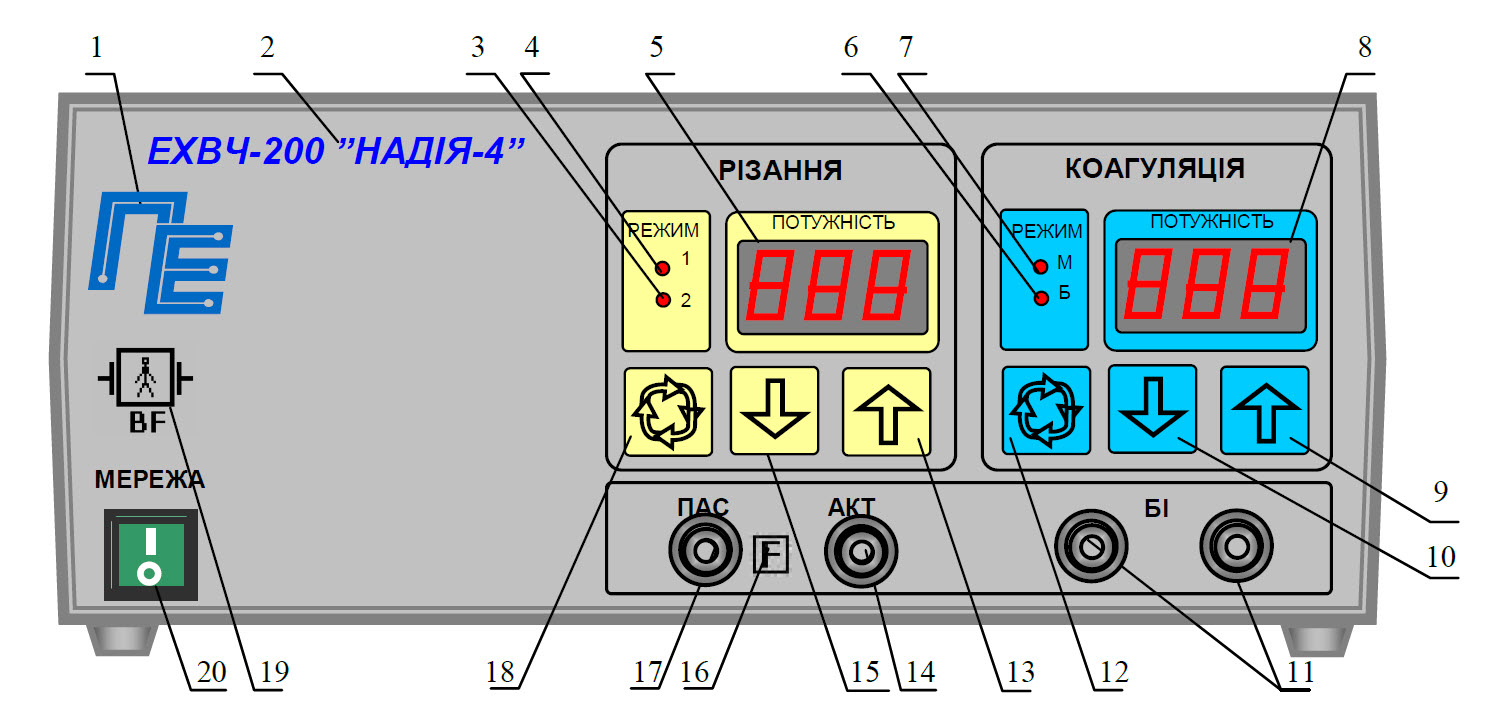
- manufacturer’s trademark;
- unit model name;
- “РІЗАННЯ-2” (CUT-2) mode indicator — blended cutting;
- “РІЗАННЯ-1” (CUT-1) mode indicator — pure cutting;
- digital cutting output power display;
- “КОАГУЛЯЦІЯ-Б” (BIPOLAR COAGULATION) mode indicator;
- “КОАГУЛЯЦІЯ-М” (MONOPOLAR COAGULATION) mode indicator;
- digital coagulation output power display;
- coagulation power increase button;
- coagulation power decrease button;
- “БІ” (BI) connectors for the bipolar electrode holder;
- coagulation mode selection button;
- cutting power increase button;
- “АКТ” (ACTIVE) connector for the active monopolar instrument;
- cutting power decrease button;
- applied-part identification symbol;
- “ПАС” (PATIENT RETURN) connector for the patient return electrode;
- cutting mode selection button;
- BF-type applied-part and defibrillator-protection marking;
- “МЕРЕЖА” (POWER) switch.
Rear panel of the electronic unit
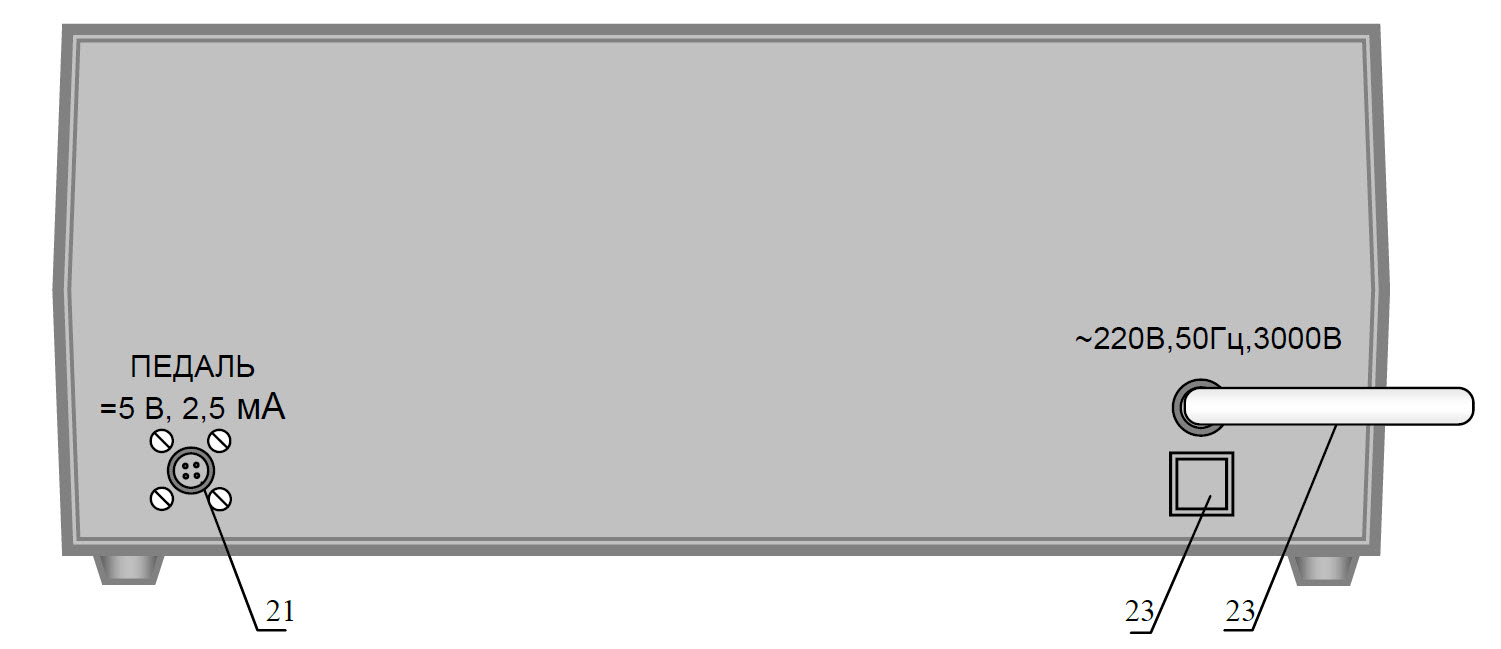
The rear panel contains the footswitch connector, electrical safety class marking and a cable for connecting the unit to a 220 V, 50 Hz AC mains supply.
Dual-pedal footswitch
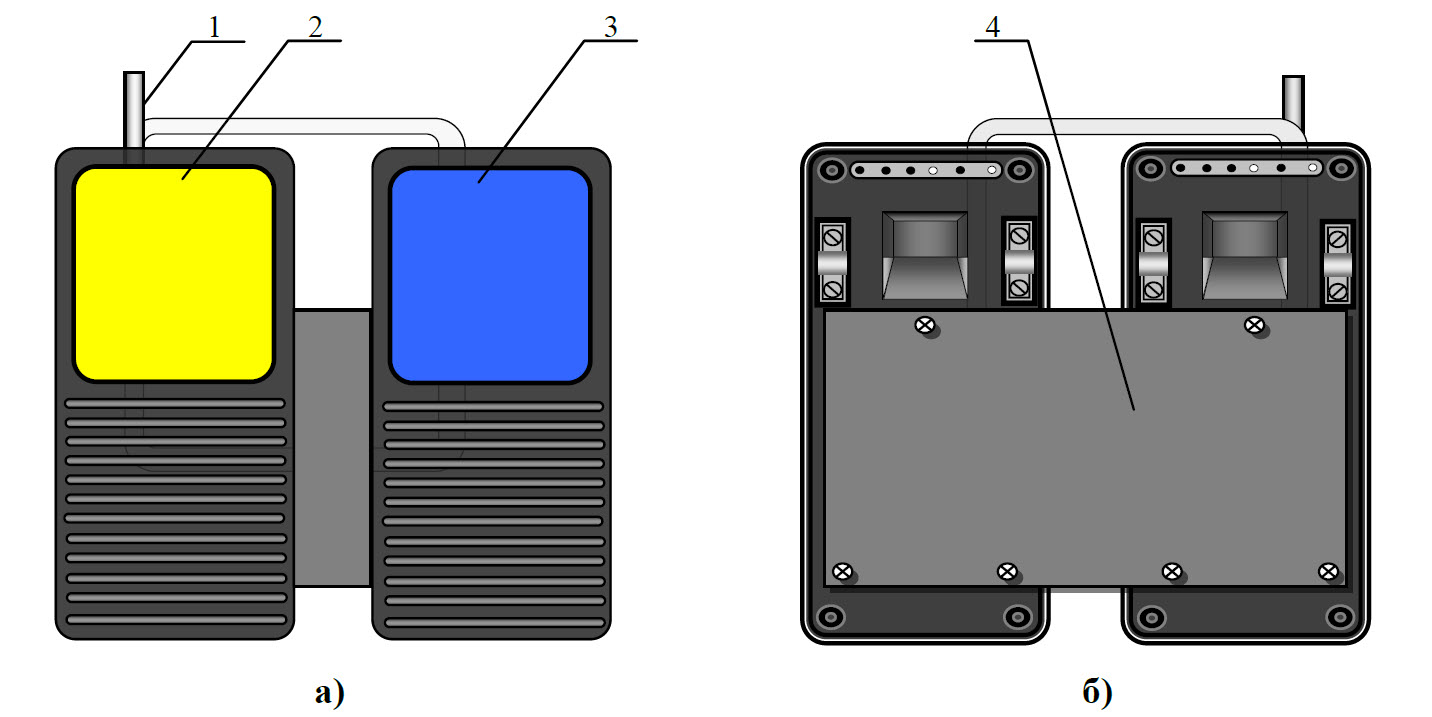
The footswitch has two separate spring-loaded pedals:
- left yellow pedal — activates the selected cutting mode;
- right blue pedal — activates the selected coagulation mode.
When pressed, the corresponding pedal moves down and activates HF power delivery. When released, the pedal returns to its initial position and the high-frequency current output stops. The footswitch enclosure has an IPX7 degree of protection.
Operating Conditions
- ambient air temperature: +10 to +35 °C;
- relative humidity: up to 80% at +25 °C;
- use in specially equipped rooms;
- duration of one HF-current activation: up to 10 seconds;
- pause between activations: 30 seconds;
- maximum continuous connection to the mains supply: 8 hours;
- the unit is not intended for connection to residential electrical networks.
Essential Safety Requirements
The HFE-200 must only be operated by trained personnel after they have read the product passport and operating manual. The output power must be set to the minimum level sufficient to achieve effective cutting or coagulation.
- during monopolar operation, reliable and complete contact between the patient return electrode and the patient’s body must be ensured;
- the patient must be insulated from metal parts of the operating table;
- electrode cables must not touch the patient or other connecting cables;
- active electrodes that are temporarily not in use must be isolated from the patient;
- when performing haemostasis through a surgical instrument, press the footswitch only after the active electrode has made contact with the instrument;
- do not keep the footswitch pressed after HF application has ended;
- in the presence of implanted stimulators, sensors or foreign metal objects, electrosurgical use must be assessed in accordance with the restrictions in the operating manual; where absolutely necessary, only bipolar coagulation is provided for;
- surgical gloves must be worn when using the bipolar forceps;
- repairs, inspections and adjustment of technical characteristics must be performed by the manufacturer’s service centres.
Do not use the unit in the presence of flammable anaesthetic mixtures, oxygen, nitrous oxide or flammable disinfectant liquids in the procedure area.
Order the HFE-200 “Nadiya-4”
Before ordering, determine the required electrosurgical modes, the types of working instruments and the equipment requirements of the operating department.
Submit a request on Nadiya-4.com to confirm the current HFE-200 “Nadiya-4” package contents, receive advice on compatible monopolar and bipolar instruments, and select equipment that meets the needs of your facility.