
|
Quantity
|
Out of stock
|
||
|
|
|||
HFE-120 Series Electrosurgical Units by Nadiya-4
The Nadiya-4 HFE-120 series includes high-frequency electrosurgical units designed for cutting and coagulation of soft tissues and blood vessels. The units support monopolar cutting, blended cutting, monopolar coagulation, and bipolar coagulation with a maximum output power of up to 120 W.
The model range includes the basic HFE-120 unit with an operating frequency of 0.44 MHz and two radio-wave versions: HFE-120RW-1.76 and HFE-120RW-3.5. The main operating modes and power output are the same for all three models, so the choice should primarily take into account the required operating frequency, the methods used by the facility, instrument compatibility, and configuration requirements.
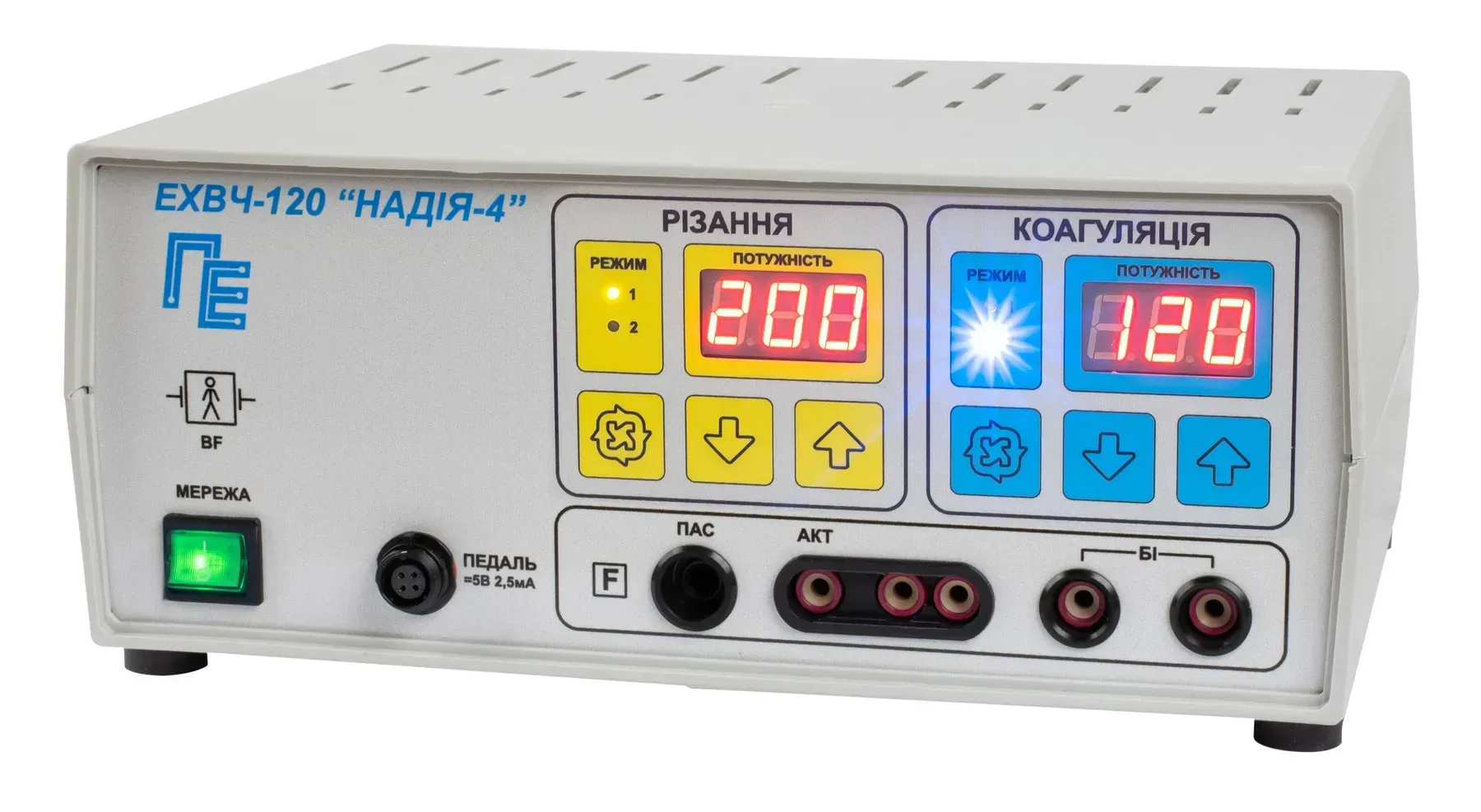
HFE-120 Model Range
The category includes three versions of the unit that differ in the fundamental frequency of the high-frequency output signal.
| Model | Operating frequency | Maximum output power | Modes | Key feature |
|---|---|---|---|---|
| HFE-120 | 0.44 MHz | 120 W | CUT-1, CUT-2, COAG-M, COAG-B | Basic model of the series |
| HFE-120RW-1.76 | 1.76 MHz | 120 W | CUT-1, CUT-2, COAG-M, COAG-B | Radio-wave version |
| HFE-120RW-3.5 | 3.5 MHz | 120 W | CUT-1, CUT-2, COAG-M, COAG-B | Higher-frequency radio-wave version |
The “RW” designation is used for the radio-wave versions of the series. A higher numerical frequency does not by itself mean that one model is universally better than another. The appropriate version should be selected according to the planned procedures, the specialist’s requirements, and the manufacturer’s recommendations.
Cutting and Coagulation Modes
All HFE-120 series units support four electrosurgical operating modes.
CUT-1
A monopolar pure-cut mode with continuous generation of high-frequency oscillations. The maximum output power is 120 W at an optimum load of 500 ohms.
CUT-2
A monopolar blended-cut mode in which the high-frequency oscillations are amplitude-pulse modulated. The maximum output power is 120 W at an optimum load of 200 ohms.
COAG-M
Monopolar coagulation using an active surgical instrument and a passive, or neutral, electrode. The maximum output power is 120 W at an optimum load of 100 ohms.
COAG-B
Bipolar coagulation in which the high-frequency current passes between the two working tips of bipolar forceps. The maximum output power is 120 W at an optimum load of 100 ohms.
| Mode | Application type | Maximum output power | Optimum load |
|---|---|---|---|
| CUT-1 | Monopolar pure cutting | 120 W | 500 ohms |
| CUT-2 | Monopolar blended cutting | 120 W | 200 ohms |
| COAG-M | Monopolar coagulation | 120 W | 100 ohms |
| COAG-B | Bipolar coagulation | 120 W | 100 ohms |
How to Select an HFE-120 Unit by Operating Frequency
Because the three models have the same output power and principal operating modes, the key selection criterion is the operating frequency:
- HFE-120 — 0.44 MHz. The basic version of the series with a fundamental HF-signal frequency of 440 kHz.
- HFE-120RW-1.76 — 1.76 MHz. A radio-wave version operating at 1,760 kHz.
- HFE-120RW-3.5 — 3.5 MHz. A radio-wave version with a fundamental frequency of 3,500 kHz.
When selecting a unit, consider not only the numerical frequency value but also the accepted procedural methods, the types of working electrodes, the requirements of the medical or veterinary facility, and the specialist’s experience.
If you are unsure which version is suitable for your work, contact the Nadiya-4.com specialists. We will help you compare the models and select the required set of instruments.
Monopolar and Bipolar Applications
Monopolar modes use an active instrument and a passive electrode. Because the active electrode has a smaller surface area, the highest current density is formed directly in the working area where tissue cutting or coagulation takes place.
Bipolar coagulation requires compatible bipolar forceps. Both working tips are active, and the high-frequency current passes locally between them through the grasped tissue.
Before each procedure, inspect the insulation of the instruments, the condition of the cables, the correct connection of the passive electrode, and whether the selected mode corresponds to the connected instrument.
Controls and Operating Monitoring
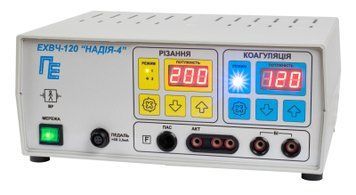
The front panel of each HFE-120 series unit has separate controls for cutting and coagulation. The selected output power levels are shown on digital displays.
A two-pedal footswitch allows the operator to activate the required function without using their hands:
- yellow pedal — cutting;
- blue pedal — coagulation.
The unit also provides visual and audible indication of the selected mode, high-frequency power delivery, and the condition of the passive-electrode cable. If the cable is disconnected or broken, an error message appears on the digital displays and a dedicated audible warning is activated.
Applications of HFE-120 Series Units
High-frequency electrosurgery is used in various areas of human and veterinary medicine. Depending on the selected version, instruments, approved methods, and staff qualifications, the HFE-120 series may be considered for use in:
- general and outpatient surgery;
- gynaecology;
- dentistry and maxillofacial surgery;
- otorhinolaryngology;
- plastic and cosmetic surgery;
- urology;
- veterinary surgery;
- educational and research institutions.
The final decision on whether a particular model is suitable for a specific application should be made with reference to the official instructions for use and the requirements of the relevant procedure.
Instruments and Standard Configuration
HFE-120 series units are used with monopolar and bipolar electrosurgical instruments. Depending on the current configuration, the supply package may include:
- electronic unit;
- two-pedal footswitch;
- passive, or neutral, electrode;
- monopolar electrode holder;
- set of monopolar electrodes;
- bipolar instrument holder;
- bipolar forceps;
- instructions for use;
- packaging.
The exact package contents should be confirmed on the selected product page, in the invoice, or in the specification. Additional footswitches, electrodes, forceps, holders, and cables are available in the “Electrosurgical Instruments” section.
Classification and Operation
The units are Class II devices with a Type BF applied part. The enclosure protection rating of the electronic unit is IP24, while the footswitch is rated IPX7. The equipment operates in an intermittent-duty mode: up to 10 seconds of high-frequency current delivery followed by a 30-second pause.
The intended service life of the unit is at least five years, provided that the operating, maintenance, and storage requirements are followed.
Before first use, personnel must read the official instructions for the relevant model. The documents are available on the product pages and in the “Instructions” section.
Warranty, Service, and Dispatch
Nadiya-4 electrosurgical units are supplied with a standard 12-month manufacturer’s warranty. Post-warranty maintenance, diagnostics, and equipment repair are also available.
In-stock products are dispatched within 1–3 business days after payment has been received and the order has been confirmed. Detailed terms are available on the “Warranty and Service” and “Payment and Delivery” pages.
Frequently Asked Questions About the HFE-120 Series
What is the difference between HFE-120, HFE-120RW-1.76, and HFE-120RW-3.5?
The main difference is the operating frequency: HFE-120 operates at 0.44 MHz, HFE-120RW-1.76 at 1.76 MHz, and HFE-120RW-3.5 at 3.5 MHz. The models have the same output power and main operating modes.
What does the RW designation mean?
The RW designation is used for the radio-wave versions of the HFE-120 series with operating frequencies of 1.76 or 3.5 MHz.
Do all models support monopolar and bipolar coagulation?
Yes. All three models support monopolar cutting, blended cutting, monopolar coagulation, and bipolar coagulation.
What is the maximum output power of the HFE-120 series?
The maximum output power is 120 W in each of the four operating modes at the corresponding optimum load.
How should I choose between 0.44, 1.76, and 3.5 MHz?
The version should be selected according to the planned procedures, accepted methods, instrument types, and the recommendations of a specialist or the manufacturer. A higher numerical frequency does not automatically mean that a model is better suited to every application.
Can instruments for the HFE-120 be purchased separately?
Yes. Monopolar electrodes, bipolar forceps, passive electrodes, holders, footswitches, cables, and adapters are available separately. Their compatibility with the selected model should be checked before ordering.
Buy an HFE-120 Nadiya-4 Electrosurgical Unit
The Nadiya-4.com catalogue offers the basic HFE-120 electrosurgical unit and the HFE-120RW radio-wave versions operating at 1.76 and 3.5 MHz.
Contact our specialists to compare the models, confirm the current configuration, check instrument compatibility, and select a unit for the needs of your facility.